
Workday Developer Agent: Prompt. Build. Deploy.

Key Takeaways
Workday Developer Agent turns plain-language requests into working Workday apps and agents in minutes, from coding tools developers already use. It pairs with Agent-Ready Tools (guardrailed data access over MCP) and Agent Passport (continuous agent security validation).
It’s available now to early access customers via Workday Extend Professional, with general availability projected for the second half of 2026.
At DevCon 2026, CloudRock built four custom agents — codenamed Project Horizon — against real professional-services use cases.
Every year, Workday DevCon gives the developer community a glimpse of where the platform is heading. This year in Las Vegas, it didn’t feel like a glimpse — it felt like a turning point. Of everything announced across the four days, one capability stood out for what it means to teams like ours and the clients we serve: Workday Developer Agent.
CloudRock was on the ground at DevCon — in the sessions, at the braindates, and in the hackathon, where our team put the new agentic tooling through its paces on real consulting use cases. Here’s what we learned about Workday Developer Agent, and why we think it deserves your attention.
What is Developer Agent?
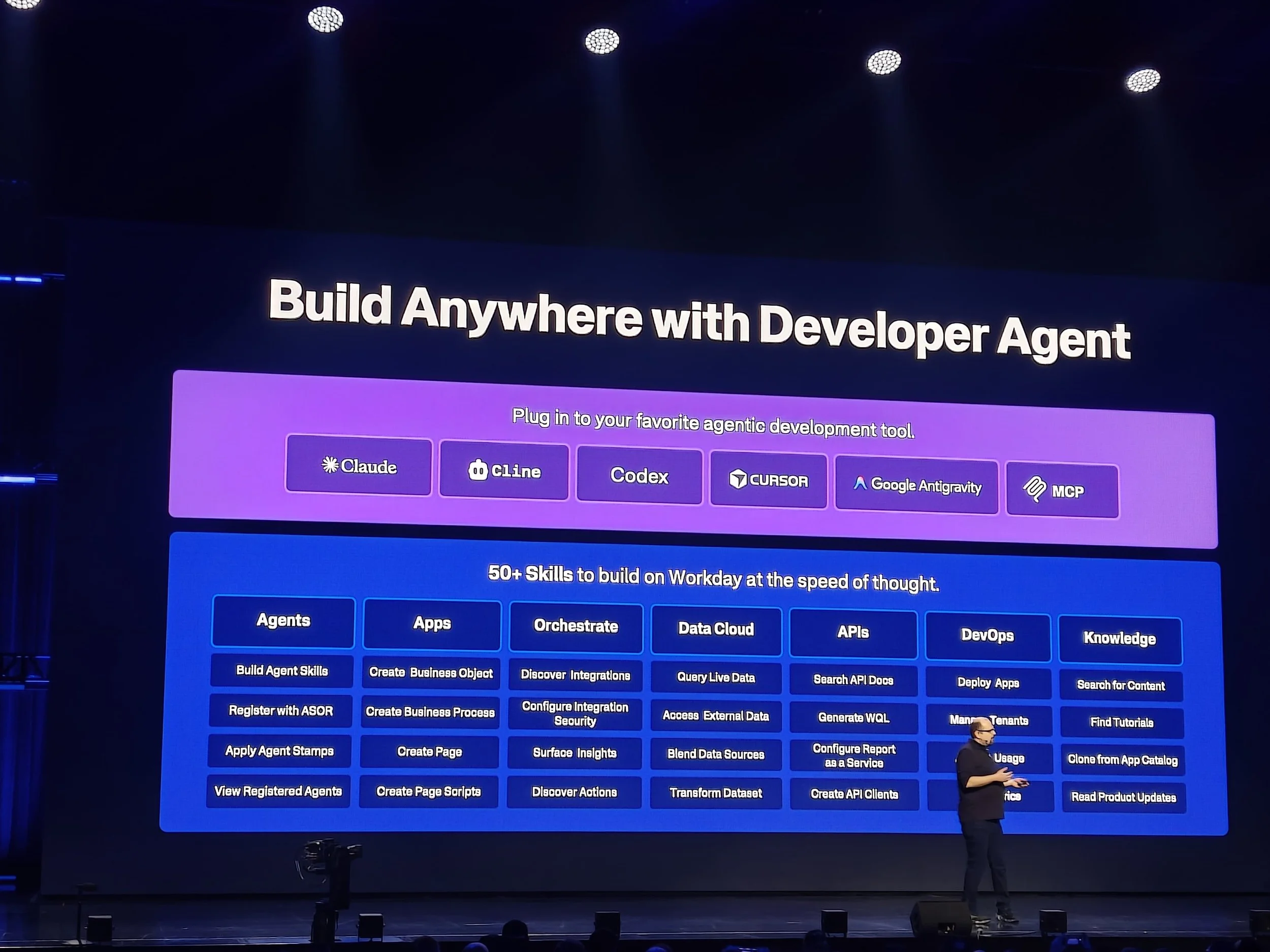
Workday Developer Agent is part of Workday Build, the platform for creating custom AI apps and agents that run natively on Workday. The headline idea is simple but powerful: developers can describe what they want to build in plain language, from the agentic coding tools they already use — Claude Code, Cursor, Codex, Cline, Google Antigravity — and Developer Agent takes them from request to working app or agent in minutes.

It didn’t arrive alone. Workday paired it with two companion capabilities that complete the picture:
Agent-Ready Tools give agents controlled, guardrailed access to HR and finance data over the Model Context Protocol (MCP) — the emerging open standard for connecting AI models to enterprise systems. This is what lets a custom-built or third-party agent act on Workday data safely, from any surface.
Agent Passport addresses the question every CIO asks next: how do we know an agent is safe to deploy? Passport tests and continuously monitors agents against recognised public standards — including the OWASP LLM Top 10, NIST AI RMF, and MITRE ATLAS — and gives them verifiable digital stamps from trusted security and compliance vendors.
Availability: Workday Developer Agent and Agent-Ready Tools are available now to early access customers through Workday Extend Professional, with general availability projected for the second half of 2026. Agent Passport follows on a similar timeline.

Why Workday Developer Agent matters: speed without losing the guardrails
The general-purpose coding agents that have transformed software development over the past two years share a common gap in the enterprise context: they help you write code faster, but they don’t understand your tenant. They don’t know your security groups, your business processes, your calculated fields, or your compliance obligations.

Workday Developer Agent closes that gap by bringing the agent inside the platform’s security and governance model rather than bolting it on afterwards. That distinction matters enormously for the organisations we work with — particularly those in regulated industries, where “move fast” has always had to coexist with “prove it’s controlled.”
In practical terms, this collapses the distance between a business need and a working solution. Workflows that previously justified a multi-week Extend build can now be prototyped in a day and hardened in a week. And because the output runs on the Workday platform — with its tenant security, audit trail, and data model intact — the prototype isn’t a throwaway. It’s a head start on production.

What we built with Developer Agent at the DevCon hackathon
We didn’t go to DevCon to watch demos. Our team entered the hackathon and built a suite of custom agents — internally codenamed Project Horizon — targeting problems we see every week in professional services delivery:
Resource Role Matcher — an agent skill that matches available consultants to backfill needs based on skills and role requirements, replacing a manual search across spreadsheets and memory.
Resource Forecast Updater — keeping project resource forecasts current through conversational updates rather than form-by-form data entry.
Manager Self-Service time review — surfacing and actioning time entry exceptions for managers without leaving their flow of work.
Project creation with agent-to-agent orchestration — chaining agents together so that approving a new engagement triggers downstream setup automatically.

Building these taught us things no keynote could. Agent skills live or die on payload structure — getting PATCH operations right against Workday’s REST APIs takes care and iteration. WQL is a fantastic query language with real limitations you need to design around. And the gap between a demo-quality agent and a production-quality one is exactly where experienced implementation judgement earns its keep.
That last point is worth dwelling on. Workday Developer Agent lowers the barrier to building, but it raises the premium on knowing what to build and how to make it safe, performant, and genuinely useful inside a live tenant. Plain-language development doesn’t replace platform expertise — it amplifies it.

What Workday Developer Agent means for Workday customers
If you’re a Workday customer, here’s our honest read on what to do with this news:
Start identifying use cases now. The best early agent projects share a profile: high-frequency, rules-describable tasks that currently force people to swivel between screens or chase data manually. Resource management, time and absence exceptions, onboarding checklists, and routine finance operations are all rich territory.
Treat governance as a feature, not a blocker.
Agent Passport signals that Workday expects customers to hold agents to the same standards as any other enterprise software. Organisations that build their agent governance muscle early — who owns an agent, how it’s tested, how it’s monitored — will scale this technology faster than those who treat it as a side project.

Don't wait for general availability to learn.
The patterns, the payload structures, the MCP integration model — these are learnable today. Teams that build fluency during the early access window will be ready to move the moment GA lands later this year.

The road ahead for agentic development on Workday
DevCon 2026 made one thing clear: Workday is no longer just a system you configure. It’s a platform you build on — and increasingly, one your agents build on with you. Workday Developer Agent is the most concrete expression yet of that shift.
At CloudRock, we’ve been building on Workday Extend, Prism, and the broader developer platform for years, and we’ve spent the past months hands-on with the AI platform, Agent Gateway, and MCP. If you’re wondering what agentic development could look like in your tenant — or you have a use case you’d like to pressure-test — we’d love to talk.
Frequently Asked Questions
-
Workday Developer Agent is a capability within Workday Build that lets developers create custom AI apps and agents on Workday using plain-language requests, working from agentic coding tools such as Claude Code, Cursor, Codex, Cline, and Google Antigravity. It takes a developer from request to a working app or agent in minutes.
-
Workday Developer Agent and Agent-Ready Tools are available now to early access customers through Workday Extend Professional. General availability is projected for the second half of 2026, with Agent Passport following on a similar timeline.
-
Agent-Ready Tools give agents controlled, guardrailed access to HR and finance data over the Model Context Protocol (MCP), the open standard for connecting AI models to enterprise systems. They allow custom-built or third-party agents to act on Workday data safely, from any surface.
-
Agent Passport tests and continuously monitors agents against recognised public standards — including the OWASP LLM Top 10, NIST AI RMF, and MITRE ATLAS — and issues verifiable digital stamps from trusted security and compliance vendors, so organisations can confirm an agent is safe to deploy.
-
General-purpose coding agents speed up writing code but don’t understand your Workday tenant — your security groups, business processes, calculated fields, or compliance obligations. Workday Developer Agent works inside the platform’s security and governance model, so the output runs natively on Workday with tenant security, audit trail, and data model intact.