
Integration Monitoring Tool (IMT): From Reactive Firefighting to Proactive Control

In any mature Workday ecosystem, integrations are the silent backbone of the enterprise. When they work, nobody notices. But when they fail, the impact is immediate and often severe missed payroll cycles, broken identity provisioning, delayed benefits updates, or stalled financial closes. Despite their importance, integration monitoring is still too often reactive. Support teams rely on manual checks, scattered inbox alerts, or raw technical logs that lack context. Issues are frequently discovered only after downstream systems or end users are already affected. This is where the CloudRock Integration Monitoring Tool (IMT) changes the game. IMT introduces a centralised, automated monitoring and observability layer for Workday integrations bringing structure, speed, and operational maturity to how integration failures are detected, managed, and analysed.

More Than Alerts:
Why Standard Notifications Fall Short
A common question we hear is, “Doesn’t Workday already notify us when integrations fail?”
The short answer is yes but those notifications come with important limitations. Standard Workday alerts tend to:
Generate repeated and often noisy emails
Treat every failure the same, without distinguishing between new issues and recurring ones
Sit outside structured support and ticketing workflows
Depend on manual review, interpretation, and follow-up
In practice, this leads to crowded inboxes, duplicated effort, and delayed response particularly when failures occur outside normal business hours. This is where we have developed Integration Monitoring Tool (IMT) and it changes the approach. Rather than adding more alerts, IMT introduces an intelligent control layer. Built natively on Workday Studio, it continuously monitors integration activity and automatically converts failures into actionable tickets within a Service Management Platform such as Freshdesk (with the flexibility to integrate with any API-enabled tool, including ServiceNow or Jira). The outcome is not just faster awareness of issues, but cleaner operations, reduced noise, and clear ownership from the moment a failure occurs.

A Simple, Native Architecture That Fits Workday
IMT is designed to sit naturally within the Workday ecosystem. It does not replace existing integrations or interfere with execution. Instead, it observes what is already happening and brings structure to how failures are handled.
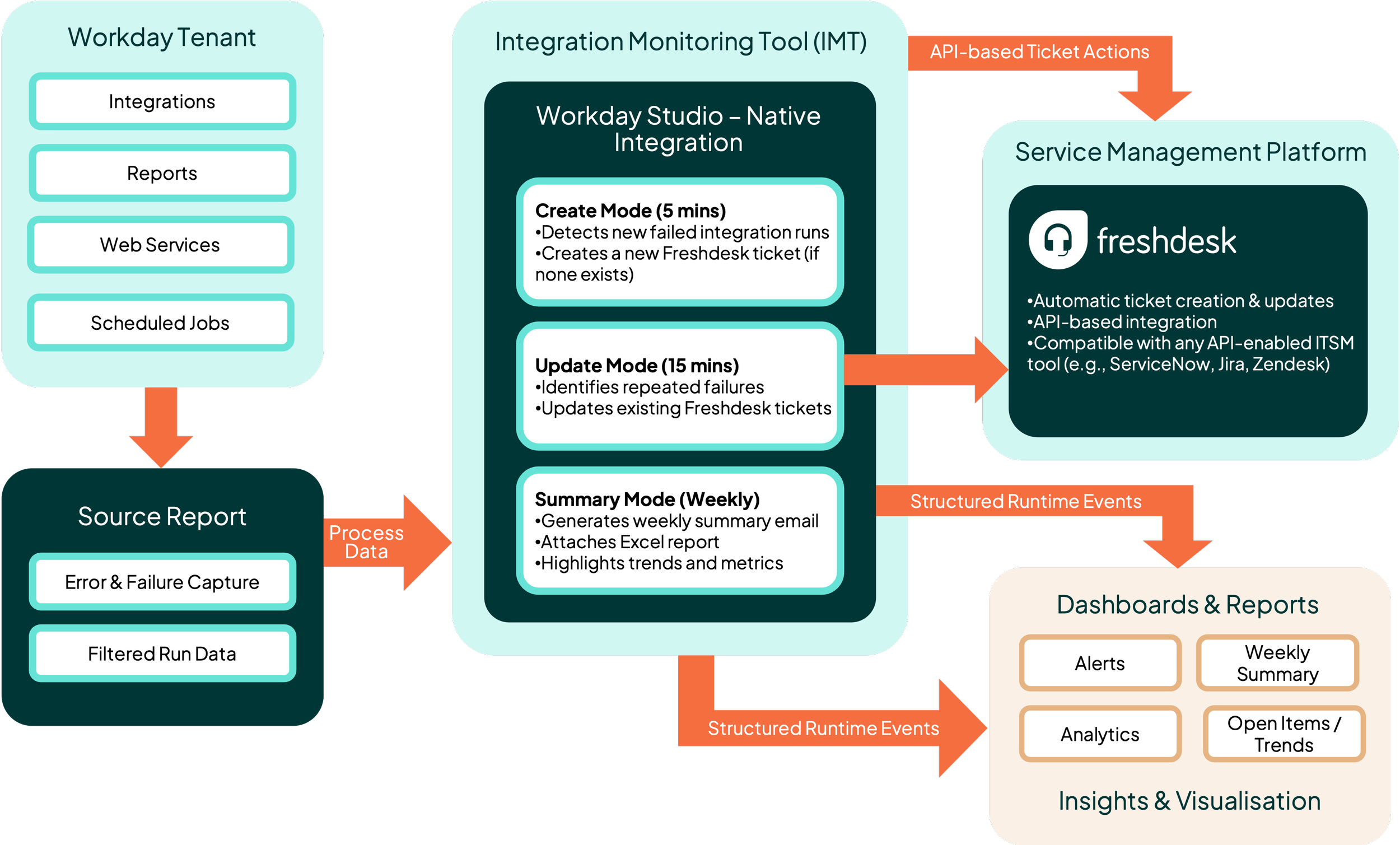
At a high level, the flow is straightforward:
Workday runs integrations, reports, web services, and scheduled jobs → A configurable Source Report captures meaningful failures → IMT processes and classifies those events → Structured tickets and insights are generated automatically.
This simplicity is deliberate. It keeps the solution secure, scalable, and easy to adapt as environments evolve.

The Measurable Impact of Proactive Monitoring
Moving from reactive monitoring to an automated observability framework delivers tangible operational improvements. In environments where IMT has been introduced, organisations have seen:
Up to 70% reduction in manual monitoring effort
Faster identification of failed payroll and finance integrations
Significant reduction in duplicate ticket creation
Improved clarity of ownership across support teams
Stronger audit trails for recurring issues
Response times for critical integrations improve not because teams work longer hours, but because the system surfaces the right issue at the right time. Monitoring shifts from a manual task to an embedded operational capability.
Flexible by Design: Monitoring That Adapts to Your Landscape
At the heart of IMT is a fully configurable Source Report within Workday. This report defines what the tool monitors. Rather than relying on a fixed feed, the Source Report can be tailored to monitor specific process types, defined domains such as Finance or HCM, named integrations, or only failed executions within a chosen time window. This flexibility allows IMT to support multiple use cases simultaneously. For example, one report can monitor Finance integrations while another focuses on HCM notifying and summarising to different groups without requiring changes to the underlying solution.
Equally important, both the monitoring scope and execution schedules are configurable. Teams can adjust what is monitored and how frequently it is reviewed whether every few minutes or aligned to weekly reporting cycles without modifying the core integration. The framework evolves alongside the Workday landscape, remaining responsive to operational priorities while preserving a stable foundation.

Behind the scenes, IMT applies structured logic to determine whether a failure is new, recurring, or part of a broader pattern. Instead of generating multiple alerts for the same issue, it ensures that incidents are handled intelligently creating tickets when required, updating existing ones when appropriate, and consolidating information for operational insight.
The specific cadence and behaviour of this monitoring are fully configurable, allowing organisations to balance responsiveness with operational efficiency. A deeper dive into these operational mechanics will be explored in a future article.

From Firefighting to Operational Maturity
Taken together, IMT represents a shift in how Workday integrations are supported. Instead of manual checks and reactive “break and fix” cycles, organisations gain:
Continuous automated monitoring
Intelligent issue handling
Clear accountability
Data-driven operational improvement
Monitoring becomes embedded within the operating model—not dependent on individual effort.
Final Thoughts
As Workday environments grow in size and complexity, integration reliability can no longer depend on inbox alerts or manual checks. The CloudRock Integration Monitoring Tool provides a practical, flexible, and proven approach to proactive monitoring, one that adapts to different domains, schedules, and business priorities without introducing unnecessary complexity. The result is fewer surprises, faster resolution, and greater confidence that integrations are doing what they are meant to do: working quietly in the background, supporting the business without disruption.